Arborist in Banora Point, NSW
Working on trees on the Banora Point slopes
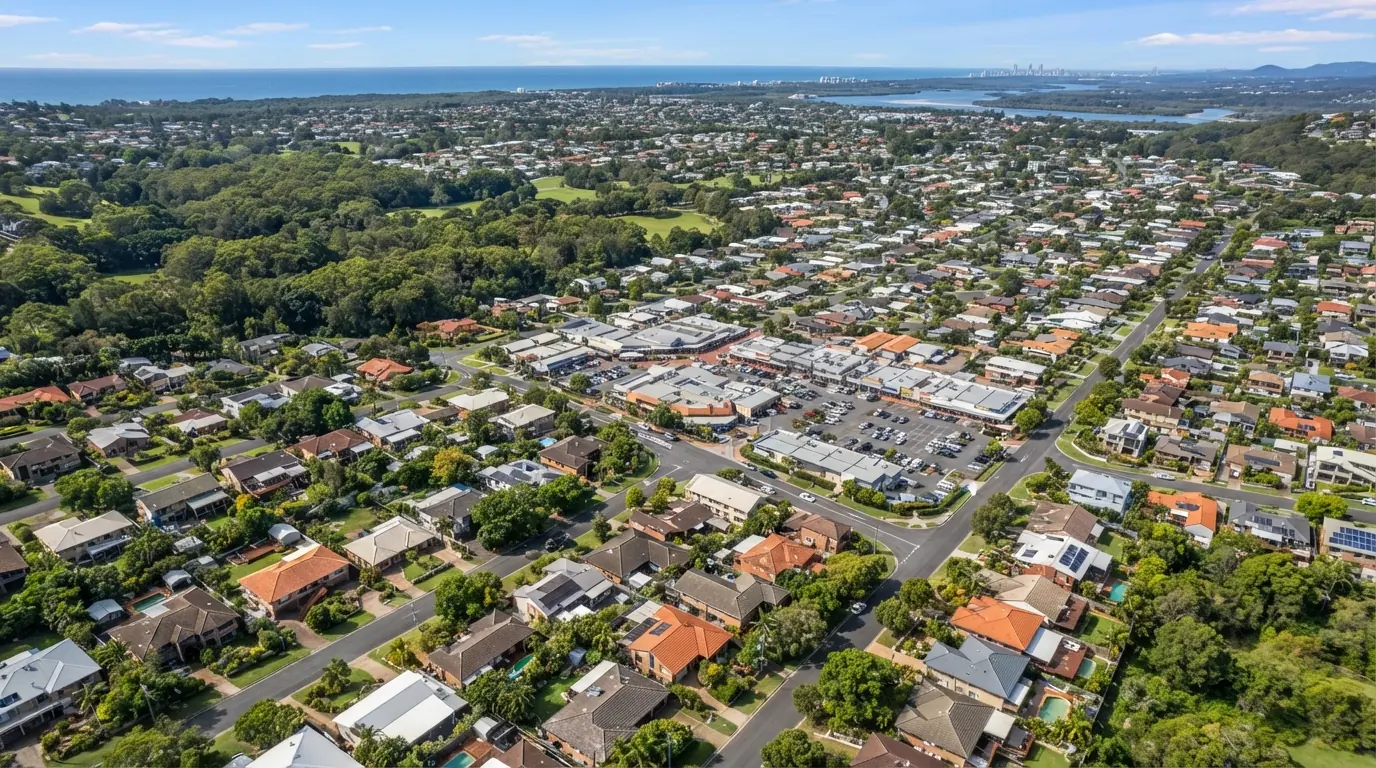
Banora Point climbs from the water of Terranora Inlet and the Tweed River up to a ridge that Leisure Drive and Darlington Drive follow. Most trees here were planted rather than left standing: gums, bottlebrush and palms put in when the estates went up, plus camphor laurels that seeded themselves in gullies and along back fences. Many gardens look out over the water, so a tall tree below a house either frames the view or blocks it, and that is often why people ring. Some streets back onto bushland where native trees lean over the boundary.
The slope shapes the work. A tree on the low side of a block can stand several metres below the road, so a truck cannot always reach it and cut sections are lowered on ropes or carried up steps. Driveways are steep, cars sit on the street, and cul-de-sacs leave little turning room for a chipper and truck. Retaining walls and terraced garden beds mean a heavy limb cannot simply be dropped. Tweed Shire Council covers Banora Point, and bushland edges can carry extra rules, so check before any large tree comes down.
Most houses date from the 1980s onward, brick and tile homes on blocks cut into the hillside, often with a pool, a pergola and a fence close to the trees. A tree planted small beside a pool or a slab has since grown large, and its roots now lift paving and push on walls. Ridge tops take the full force of a storm, while gullies stay damp and grow weedy, fast and brittle. Both situations bring different work to the same street.
What we do here most
What the hillside keeps asking for
The pattern here is a tree that was fine when the garden was new and now sits too close to a pool, a wall, a roof or a view.
Tree Trimming
Trimming a gum that blocks the inlet view
A gum below a house can grow up into a view that was the reason for buying it. The climber takes height and side growth off in stages, working from the top down, and drops each cut piece to a spot the ground crew have cleared. The aim is to open the view and leave the tree balanced, not stripped.
Stump Grinding
Grinding a stump beside a retaining wall
After a tree comes down on a terraced block, the stump often sits right beside a wall or a garden bed. A compact grinder goes in on its tracks or is carried in, and the stump is ground below ground level. Before it starts, the crew look for pipes and cables, since a pool line or irrigation can run close to the roots.
Tree Limb Removal
Taking one heavy limb off over a pool
One big limb can hang over a pool, a pergola or a neighbour's roof while the rest of the tree is healthy. It is cut in short sections and lowered on a rope so nothing lands on the water or the tiles. The tree stays, and the weight that threatened the house comes off it.
Root Removal
Roots lifting paving beside an older pool
Roots from a fast-growing tree planted near a pool or a driveway can lift pavers and push against a wall. The crew open up the ground, find which roots are doing the damage, and cut them out. Where a tree must go, the stump and its main roots are taken out so the paving can be relaid.
If it is urgent
If a branch comes down on a Banora Point slope or fence
- 1Keep people and pets away from the fallen branch, and stay well back from any limb that is touching a wire.
- 2Do not climb the tree, do not cut a limb that is bent or under tension, and do not go near any wire.
- 3When you ring 0458 795 659, tell us the street, whether the tree stands above or below the house, and what the fallen limb is resting on.
Common questions
Frequently Asked Questions
Which areas do you cover?
Tweed Heads, the Tweed Coast, Murwillumbah and the Tweed Valley, and the southern Gold Coast as far as Palm Beach and Tallebudgera. Each place has its own page on the service areas page. If yours is not listed, ask, because the list is where we work most often rather than a boundary.
Do you work in Queensland as well as New South Wales?
Yes. The work crosses the border at Tweed Heads and Coolangatta and carries on through Gold Coast suburbs such as Currumbin, Elanora and Bilinga. Which council a tree falls under changes with the side of the border, and that can change what you need to check before a tree comes down.
Which tree jobs do you do?
Trimming, pruning, tree and limb removal, stump grinding, root removal, chipping and mulching, palm tree removal, land clearing and fire breaks, arborist services, commercial tree work, crane-assisted removal and emergency tree work. Each job has its own page on the services page.
Do you do emergency tree work?
Yes. Emergency tree service is one of the jobs on the services page. We are open 24 hours a day, Monday to Saturday, and closed on Sundays. Ring 0458 795 659, say what has come down and what it is lying on, and keep everyone well back until we have spoken.
What is the difference between pruning and lopping?
Pruning takes a branch off at the branch collar, the swelling where it joins the trunk, so the tree can seal the wound. Lopping cuts through a branch anywhere along its length and tends to leave a stub that decays. Pruning is the method for a tree that is staying.
What happens to the branches and the mulch?
Branches and leaves are put through a commercial chipper on site. You can keep the mulch for your garden beds or have it taken away, whichever suits the block.
How far down is a stump ground?
Below ground level, so the spot can go back to lawn, paving or a new planting. Roots are taken out as well when they need to be, and the chips and debris are dealt with as part of the job.
How often do palm trees need cleaning?
Once or twice a year is usual. The job is taking off the dead brown fronds, seed pods and berries that would otherwise land on paths, cars and people.
Do I need council permission to remove a tree?
Often you do, and it varies. Tree preservation rules depend on the council, the zoning, the size of the tree and whether it is a native or protected species. Check with your council before a large or protected tree comes down.
What is crane-assisted tree removal?
A crane takes the weight of each section while a climber makes the cuts, then lifts it clear. It is used for trees that are large, dangerous or too hard to reach any other way, such as ones standing over a house or close to power lines.
What should I tell you when I call?
Where the tree is, roughly how tall it is, what it stands near, such as a roof, fence, pool or wire, and whether it is leaning or has split. A photo taken from a safe distance helps. Say whether a truck can reach the back yard too.
What should I do if a tree or limb is touching a power line?
Stay well back, keep people and pets away, and do not touch the tree or anything it is touching. Treat the line as live and ring 000 if anyone is at risk. Once everyone is clear, ring the number at the top of this page and tell us what is touching what.
Everything we do here
Services in Banora Point, NSW
Each service below gets used on the Banora Point hillside, where slope, retaining walls and views change how every job is done.
Also nearby
We work in these suburbs too
Local, and on the phone
Tell us about your Banora Point tree
Send or say whether the tree stands above or below the house, how steep the drive or path to it is, and whether a truck can park close. That decides if the pieces are lowered by rope, carried up or driven out.
0458 795 65924 hours a day, Monday to Saturday
Not urgent? Send us the job instead